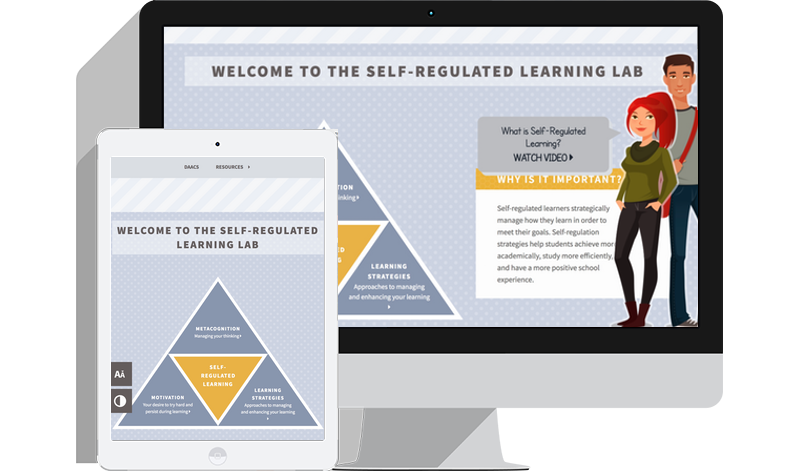
Rethinking College Readiness

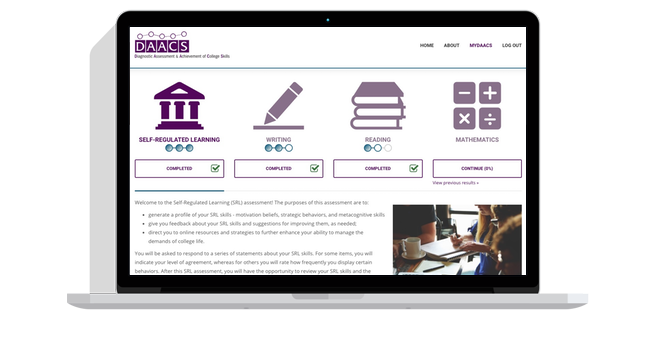
In the past, newly enrolled college students had little reliable information about their readiness for college-level academic work. DAACS addresses this problem by providing students with detailed information and feedback on their preparation for college, as well as resources for shoring it up. By using DAACS, students can build needed skills in areas of self-regulated learning, writing, reading, and mathematics while enrolled in courses that lead to the completion of their degrees.

Focussing on the Whole Student

Current research suggests that self-regulated learning, mindset, and motivation are better predictors of college success than traditional placement or entrance exams. DAACS places emphasis on these areas and provides students with concrete strategies for becoming a more successful college student.

Predictive Analytics

Data provided by DAACS has been shown to increase the efficacy of predictive analytic models. These data not only help institutions identify their most academically at-risk students, but also provide specific information as to how they are at risk. With this information, more targeted interventions can be developed that better serve students’ needs.

Do you want to see more?

Take the Diagnostic Assessment and Achievement of College Skills and receive personalized feedback about your college readiness in self-regulated learning, reading, writing, and mathematics.

Take DAACS

What's New

Recent research, presentations, and news from the DAACS team.

Predictive validity evidence for a no-stakes, untimed, machine-scored diagnostic writing assessment

By DAACS on January 16, 2026

Predictive validity evidence for a no-stakes, untimed, machine-scored diagnostic writing assessment Authors: Elie ChingYen Yu, Oxana Rosca, Heidi L. Andrade, Angela M. Lui, and Jason Bryer Abstract The Diagnostic Assessment and Achievement of College Skills (DAACS) is a free, online system for assessing and promoting newly enrolled college students’ readiness in reading, writing, mathematics, and self-regulated learning. The system provides instant, personalized feedback and resources to promote success in college.

Continue reading

DAACS at 2026 AERA & NCME

By DAACS on January 15, 2026

We look forward to seeing you at our upcoming presentations LOS ANGELES, WEDNESDAY, APRIL 8, TO SUNDAY, APRIL 12, 2026 American Educational Research Association (AERA) Bryer, et al. (2026, April). Free will as an obstacle to randomized controlled trials. Paper presentation at annual meeting of AERA. [Division D - Section 2: Division D - Measurement and Research Methodologies / Division D - Section 2: Statistical Theory and Quantitative Methods]

Continue reading

DAACS at 2025 American Educational Research Association (AERA)

By DAACS on April 27, 2025

Fortunately, talk is cheap: Commitment language is associated with academic success in college Sunday, April 27th, Denver, CU Elie ChingYen Yu, Heidi L. Andrade, David W. Franklin, Angela M. Lui, Jason Bryer Abstract The impact of goal setting on self-regulated learning (SRL) has been established by educational psychology research, while counseling psychology research has documented the importance of goal commitment strength. This study of students’ written reflections on their SRL examines the associations between commitment strength, motivation, and GPA.

Continue reading

DAACS at 2025 American Educational Research Association (AERA)

By DAACS on April 26, 2025

Identifying and Distinguishing College Readiness Profiles Across Academic Outcomes: The Importance of Integrating Academic Skills and Self-Regulated Learning Saturday, April 26th, Denver, CU **Timothy J. Cleary, Jason Bryer, Elie ChingYen Yu ** Abstract The current study identified college readiness profiles of newly enrolled college students (n=6,376) and examined differences among these profiles across engagement and on-time progress. Based on academic (reading, mathematics, and writing) and self-regulated learning (SRL) variables gathered from the Diagnostic Assessment and Achievement of College Skills (DAACS), K-means cluster analysis revealed five distinct profiles.

Continue reading